Perception shouldn't be
rebuilt by every agent.
Every agent today burns tokens and reasoning cycles to perceive what is already knowable about the world. Perception is not a per-agent problem. It should be a utility, a shared engine an agent calls instead of reinventing.
Skill, tool, engine.
The layer that bridges agentic AI to physical AI. One machine-readable planet an agent reads to decide, and soon a robot reads to act.
Read the conceptOne thing, done right once, with its source attached.
A capability an agent calls, auditable all the way down.
The world's perception, paid once, read by everyone.
One brain for the ground.
Read three ways.
Humans
Open the twin and read the ground: places, roads, buildings, traffic, events, satellites. Every number ships its provenance, so you can audit a call, not just trust it.
AI agents
Call the layer over MCP and a plain API. Agents offload the token cost and reasoning of perceiving the world to us, and spend their budget on deciding instead.
Robots (soon)
A sovereign, machine-readable map for embodied agents to navigate and act on: one shared view of the ground that devices can coordinate across.
Digital Twin Earth
A living, open replica of the planet's data. Places, roads, buildings, traffic, satellites, ships, flights, events and weather on one globe, in real time, wired under a single API an agent can call the moment a decision matters.
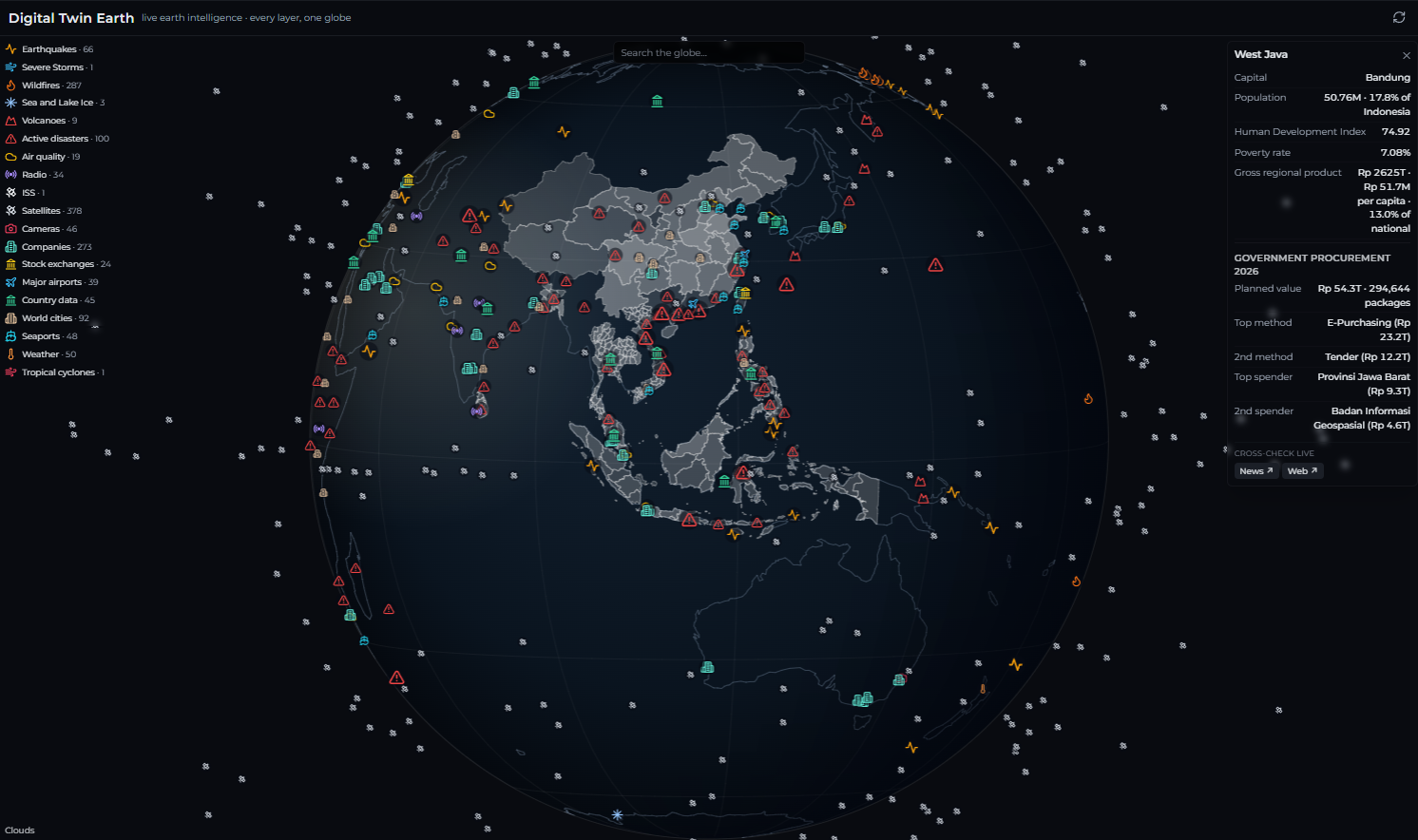
- 9,000+
- live signals on the globe
- 1,700+
- composable views
- Real-time
- streamed, not snapshotted
- Open
- data, keyless
Earth-2 simulates the planet. Solyzer lets agents act on it.
NVIDIA Earth-2
Models the planet's physics for scientists. Simulation-grade, heavy, offline. Built to predict climate and weather.
Solyzer Analytics
A light, live, decision-grade perception engine in the cloud. Built for agents to read the ground and act, in the moment, at the pace of a request.
Real ground, honestly read.
Not a demo. These read the actual world today, and every one ships the caveat that keeps it honest.
Buildings become geometry
Dense Google Open Buildings footprints with per-polygon confidence, fused with contained POIs, auto-labeled with a disclosed confidence mix, occupancy and real frontage measured.
Traffic equilibrium
Every street's scenario fingerprint and speed distribution, modeled from its physical structure, not scraped counts.
Satellite context
Sentinel-2 vegetation and built-up, VIIRS night-lights activity, disclosed as coarse area priors.
Street-level fingerprint
Mapillary street photos read into measured facts (roadway width, kerbs, gates, signage, overhead clearance) with in-scene scale calibration. Facts, never re-rendered imagery.
Live events
GDACS hazards joined to exposed places, lifelines and rivers, with per-figure confidence and bbox honesty.
Observation windows
When imaging satellites next pass a point, so fresh ground truth can be timed, not guessed.

Powered by Hudhudbird Perceptrons.
The twin's perception is not a black box. It runs on Hudhudbird Perceptrons, an open framework that cross-checks every reconstruction against independent references and prices uncertainty into every figure. Hudhudbird builds perception. Solyzer builds the world.
Agents don't just read the map.
They meet on it.
Soon agents contribute to the twin, negotiate over it, and coordinate across devices through a shared, sovereign view of the ground, the playground where autonomous systems and embodied robots reason about the same world together.